 Water Sort Games
Water Sort Puzzle: History, Rules, Strategy & Variations
Discover how Water Sort became popular, learn the pouring rules and empty-bottle strategy, and explore ball sort, hidden-color puzzles, and more variations.
By Water Sort Games · Published
What is Water Sort? A color sorting puzzle in bottles
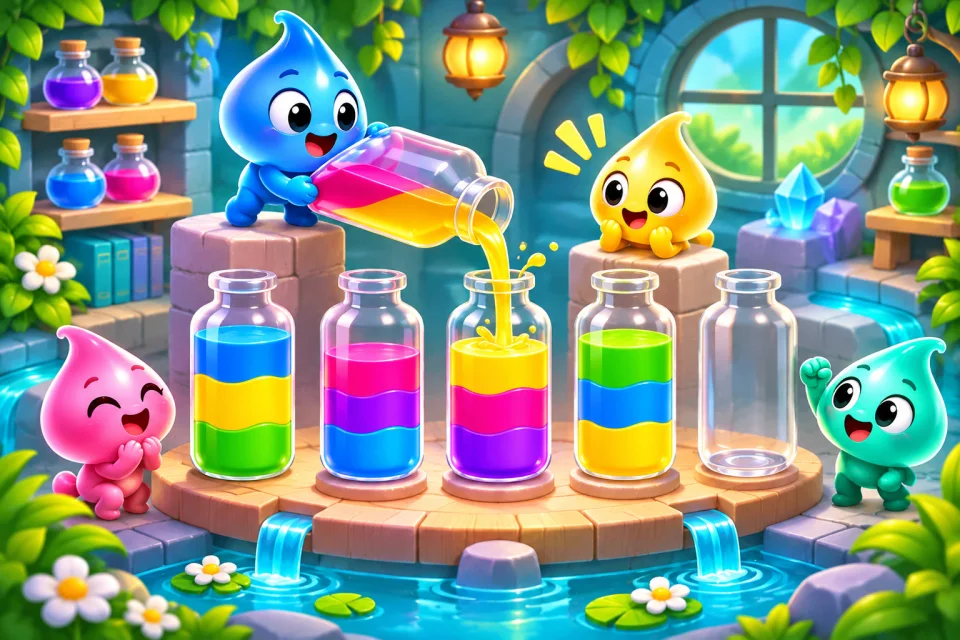
Water Sort is a logic puzzle about moving layers of colored liquid between containers until each color has its own bottle. You select a source, choose a legal destination, and work around limited space. The interesting part is reaching colors buried under other colors without filling every available container.
Water sort puzzle, water color sort, liquid sort puzzle, and bottle sorting game often describe this same basic idea. They are genre terms used by many different games, rather than the name of one universal app. Individual releases can have different levels, tools, completion rules, and business models.
If you have seen an advertisement showing a row of rainbow-filled test tubes, this is usually the puzzle behind it. Here is how the genre reached a large audience, how the classic rules work, and which variations actually change the decisions you make.
When did Water Sort become popular? The 2020–2021 growth period
The available evidence places Water Sort's early mass-market growth around 2020–2021. An InMobi case study discussing IEC Corp's results through November 2020 already describes Water Sort Puzzle as a title with more than 10 million Android downloads. That establishes an early audience; it does not establish who invented the genre.
A dated snapshot makes the 2021 breakout easier to measure. In its April 15, 2021 report, app intelligence company 42matters ranked IEC's Water Sort title first in its list of trending Android games by US downloads over the preceding 30 days. Its estimates were about 3.10 million US Android downloads and 22.51 million worldwide Android downloads in that window. The report also included the iOS title in its US top ten. These are estimates for particular apps and a particular period, not total downloads for the entire genre.
The audience subsequently grew much larger. When checked on November 13, 2026, IEC Global's Google Play listing displayed the 100M+ downloads milestone. Store milestones are rounded cumulative thresholds, not a measure of current monthly players. Together, the early case study, dated market snapshot, and current listing show sustained reach without requiring an unsupported claim that one viral video created the category.
Why did Water Sort become so popular?
Our reading of the design is that Water Sort combines an instantly visible goal with a less obvious solution. Mixed colors look unfinished; matching colors look organized. A viewer can understand the objective from a short demonstration, while the first difficult board reveals that a legal pour can still be a poor decision.
The controls also suit a phone. Selecting two bottles takes little physical effort, yet choosing those bottles can require several moves of planning. A puzzle gives you a small task to return to during a break, and a completed bottle provides visible progress before the whole board is solved.
Pouring animations make the change easy to follow. Where a game includes liquid sounds and gentle effects, the presentation can add an ASMR-like appeal. The strategic payoff is more concrete: an awkward arrangement becomes a clean set of colors through your own choices. This is an explanation of the design's appeal, rather than a measured claim about every player's motivation.
There is also documented commercial context. InMobi's IEC case study describes the publisher's reliance on in-app advertising and its use of banners, interstitials, and rewarded videos across its apps. That helps explain how free casual games can be funded at scale. It does not, by itself, prove which advertising channel caused Water Sort's growth or how much any single title earned.
How to play Water Sort: the classic pouring rules
Start by reading each bottle from top to bottom. Only the exposed top color can leave a bottle. To reach a lower layer, you must first move what is above it. The following are the standard rules for the classic equal-capacity puzzle; a particular game can add exceptions.
- Select the source bottle, then select the destination bottle.
- Pour into an empty bottle, or onto a bottle whose top color matches the color you are moving.
- The destination must have free capacity. A full bottle cannot accept more liquid.
- In the usual water-move rule, a pour transfers as much of the consecutive matching top block as will fit. You do not freely choose a lower layer or an arbitrary amount.
- Finish with each color consolidated into its own bottle and any spare bottles empty. In standard boards, each color has enough liquid to fill one bottle. Some apps use different completion checks, so follow the objective shown in your game.
A small Water Sort example solved in four pours
Consider three colors and four bottles, each with room for two units. The table lists the bottom layer first and the top layer second. This smaller board follows the same planning principles as the familiar four-layer water sorting puzzle.
Move the blue from A into D. Next, pour the red from C onto the red in A. Pour the green from B onto the green in C. Finally, pour the blue from D onto the blue in B. A is now all red, B all blue, C all green, and D empty.
The opening pour does not complete a color. Its purpose is to expose the red in A, which makes the next pour possible. That is the central habit to learn: judge a move by what it unlocks as well as by the color it moves.
| Bottle | Bottom layer | Top layer |
|---|---|---|
| A | Red | Blue |
| B | Blue | Green |
| C | Green | Red |
| D | Empty | Empty |
- Pour 1: A → D
- Pour 2: C → A
- Pour 3: B → C
- Pour 4: D → B
Water Sort strategy: use empty bottles as working space
An empty bottle is flexible storage: unlike a partly filled bottle, it can accept any exposed color. Using it well often matters more than completing the first attractive color match. Before spending your last empty bottle, identify a sequence that will create another one.
Imagine that moving a two-unit blue block exposes a red layer. The pour is useful if that red can immediately join another red stack, perhaps emptying its source. It is less useful if both the blue block and the newly exposed red have nowhere to go. Look for a chain of openings rather than an isolated match.
There is no simple move that wins every board. These habits help you compare options, but they are planning tools rather than a guarantee of a shortest solution.
- Look one layer deeper: ask which color becomes accessible after the pour.
- Count free units, not just empty bottles. A matching destination with one free unit cannot receive a whole three-unit block in one pour.
- Prefer moves that expose a needed color, empty a container, or finish a color without trapping the rest.
- Avoid repeatedly transferring a single-color stack between empty bottles unless the move serves a specific purpose.
- Treat a completed full bottle as settled when possible; using it as temporary storage is no longer an option under classic capacity rules.
- If undo is available, return to the last meaningful choice and try a different opening rather than repeating the same loop.
Why can't I pour water, and why do levels get stuck?
A rejected pour usually has a local explanation: the destination is full, its top color does not match, or the source has no movable liquid. A special bottle may also be locked by that game's own rules. Check these conditions before assuming the controls are broken.
Getting stuck is a broader problem. You may still have several legal moves, but none may release the color you need. Filling the final empty bottle can remove the temporary storage needed to untangle the remaining stacks. Repeating the same transfers can also leave you cycling through equivalent positions.
Try undoing to the point where you spent your last useful space. Look for an alternative that empties a source bottle sooner. If you restart, change an early decision and observe what becomes accessible. A dead end reached during play does not prove that the starting puzzle has no solution.
Water Sort vs Ball Sort: what is the difference?
Ball Sort represents colors as separate balls stacked inside tubes. A classic ball move transfers one exposed ball; a classic water move transfers a consecutive top block of the same color, subject to destination space. Some apps automate repeated ball moves, so the number of taps is an interface detail as well as a rule difference.
The shared challenge is access: the piece or layer you want may be buried. Both puzzles ask you to manage matching tops and spare capacity. Moving a blue block in Water Sort can correspond to several blue-ball moves in Ball Sort.
The 2022 research paper Sorting Balls and Water: Equivalence and Computational Complexity proves equivalence of solvability for its formal ball and water models. It also proves the general problem NP-complete. Those results do not say that all commercial versions have identical levels, move counts, or difficulty; they explain why such simple rules can support demanding puzzles.
Water Sort variations: which changes affect the puzzle?
A new theme can make a familiar puzzle feel fresh, while a new constraint can require a different strategy. The useful distinction is whether the variation changes information, storage, legal moves, or the objective. The table compares several forms you may encounter; features vary by release.
| Format | What changes | Planning priority |
|---|---|---|
| Classic water sort | Visible layers and limited bottle capacity | Expose buried colors and recover empty space |
| Ball sort | Separate pieces replace liquid blocks | Track top pieces and the game's transfer rule |
| Hidden-color water sort | Lower layers remain unknown until exposed | Preserve flexibility while gathering information |
| Daily challenge | A scheduled puzzle or reward structure | Check reset rules and whether boards are shared |
| Timed water sort | A clock adds a failure condition | Plan a short sequence before tapping quickly |
| Potion sort or soda sort | Themed containers, sounds, and presentation | Check whether the underlying rules actually change |
| Nuts and bolts sort | Colored nuts stack on bolts | Free buried nuts while respecting capacity |
Daily Water Sort challenges and timed sorting modes
A daily challenge describes a release schedule or progression system, not one standard pouring rule. An app may offer a new board, a daily reward, or an event challenge. One Google Play listing titled Water Sort – Color Sort Puzzle explicitly advertises daily challenges and gems. Before comparing results with another player, check that you have the same app, date, mode, and starting board.
Timed modes add a different source of difficulty. Water Sort 3D – Color Puzzle, for example, advertises a Time Bomb Rush mode alongside classic and mystery modes. With a clock running, recognizing useful patterns quickly matters, but a fast sequence of unplanned pours can still block the board.
Our site also has a game called Daily Water Sort. Its current description promises stages and assistance tools; the title alone should not be taken as a promise of one shared puzzle or a particular midnight reset. Read the game page for the features actually available.
Potion sort, soda sort, and Water Sort 3D
Potion and drink themes give the same layers a different setting: magical mixtures, soda bottles, or cups of colorful liquid. Grand Games' Magic Sort!, for example, presents water sorting as a magical adventure with potions. A themed game can retain the familiar goal of collecting one color per bottle.
Likewise, 3D can describe rounded glass, lighting, camera perspective, or animation without changing the legal moves. To decide whether a version offers a new challenge, ask practical questions: Are the layers visible? Can the same colors move to the same destinations? Is there a new capacity rule or a new objective?
Presentation still matters. Distinct colors, readable layers, and bottles that remain clear on a small phone make planning easier. If a decorative bottle shape makes the bottom layer hard to see, changing the theme may be more useful than changing your strategy.
Water Sort online vs offline: do you need a download?
A browser Water Sort game is convenient when you want to open a link and play without installing an app. On this site, you can start from the home page or open Magic Water Sort's game page. A mouse click and a phone tap serve the same basic selection role.
An installed app may be a better fit when offline access is the priority. IEC's Google Play description explicitly advertises offline play, but that does not establish offline support for every Water Sort release. Browser games normally need a connection to load unless they explicitly support offline caching.
Free, offline, and ad-free describe different things. A free app can contain advertising or optional purchases; offline support does not tell you which tools require a connection. Before choosing a version, check its store labels, undo and hint rules, save behavior, and whether the colors are comfortable to distinguish.
Water Sort level solutions and solvers: match the actual board
Searching for Water Sort level 100 solution or level 500 walkthrough is only useful after identifying the game. Different developers can assign the same number to entirely different boards. Even within one app, an update, challenge mode, or generated level can change the arrangement.
Compare the bottle count, capacity, every visible layer, spare containers, and special rules before following a video. A reliable solution names the app and shows the initial board. A generic list of taps for a level number cannot cover all games using that number.
A Water Sort solver needs the same precision. It must know the starting stacks, their orientation, the legal transfer rule, and the goal condition. Hidden colors make a fully specified input impossible until they are revealed. A tool returning no answer might have reached its search limit or received an incorrectly entered board; that result alone is not proof of impossibility.
The computational complexity research helps explain why solving arbitrary large boards is demanding. It does not imply that a normal small level is impractical, or that an extra bottle must be purchased. We do not provide an automated solver on this site; the rules and strategy guides are a starting point for planning your own moves.
Water Sort FAQ: common rules, difficulty, and gameplay questions
Is Water Sort the same as a water pouring or water jug puzzle?
In this article, Water Sort means separating colored layers into matching bottles. A measuring puzzle that asks you to obtain an exact volume in jugs has a different objective. Check whether a game is asking you to sort colors or measure a quantity.
Do colors mix when you pour in Water Sort?
Under classic rules, colors remain separate layers. Blue and yellow do not become green. A move normally requires an empty destination or the same exposed color, so the puzzle is about rearranging layers rather than simulating paint mixing.
How many empty bottles do you need in Water Sort?
There is no universal number for every board and ruleset. Many familiar layouts include spare bottles, but solvability depends on the arrangement, capacity, and transfer rules. An extra bottle increases flexibility; it does not explain whether your original starting board was solvable.
Can every Water Sort level be solved without an extra bottle?
That depends on the specific level. A puzzle designed and verified for its original bottle count can be solved from its starting position, although your current sequence may have reached a dead end. You cannot infer the solvability of every randomly assembled or commercial board from the genre name.
What is the best first move in Water Sort?
Compare what each move exposes and how you will recover space. A useful opening often starts a sequence that empties a bottle or unlocks another color. Simply taking the first available matching pour is not a universal strategy.
Why do some Water Sort games pour several layers at once?
Consecutive top units of the same color form one block under the usual water-move rule. The pour transfers that block until it ends or the destination fills. Other apps may implement transfers differently, so watch one move before copying a walkthrough.
Does Water Sort have a time limit?
A timer is a mode-specific feature. Some games offer untimed sorting, while others add timed challenges. Read the current mode's rules rather than assuming that all Water Sort games are either timed or untimed.
Is Water Sort relaxing or good for your brain?
The puzzle asks you to track colors, plan moves, and reconsider blocked routes. Some players enjoy that focused routine, especially without a timer. Enjoyment and practice at a puzzle do not establish a medical benefit, an IQ increase, or a general improvement in memory.
Start with a classic board, then explore a variation
A small visible-color board is a useful place to learn because you can see the consequences of each pour. Try identifying the color a move will expose before you tap. Once that feels natural, hidden layers, timed rounds, or another sorting format give you a specific new skill to practice.
Use the links below to play a browser version, check the full rules, or work on space management. The best next challenge is one whose actual rules and starting position you understand.